Burnham Baroque
Burnham Baroque is the name critics gave to the grandly ornamental classical mode developed by Daniel Burnham's office at the turn of the 20th century - the ceremonial side of his practice, alongside the planning and skyscraper work that made him famous. Pittsburgh's Pennsylvania Railroad station and Washington's Union Station (1903-07), with its colossal triumphal-arch entrance and vast waiting room, are its touchstones; the Reliance Building's terracotta-dressed shaft shows the same appetite for ornamented verticality. The style fuses Beaux-Arts symmetry and classical orders with lavish terracotta decoration on an urban scale, aiming for civic splendor. The label itself, applied by critics to Burnham's railroad stations, marks how strongly this sweeping historicism impressed - and sometimes amused - contemporaries.
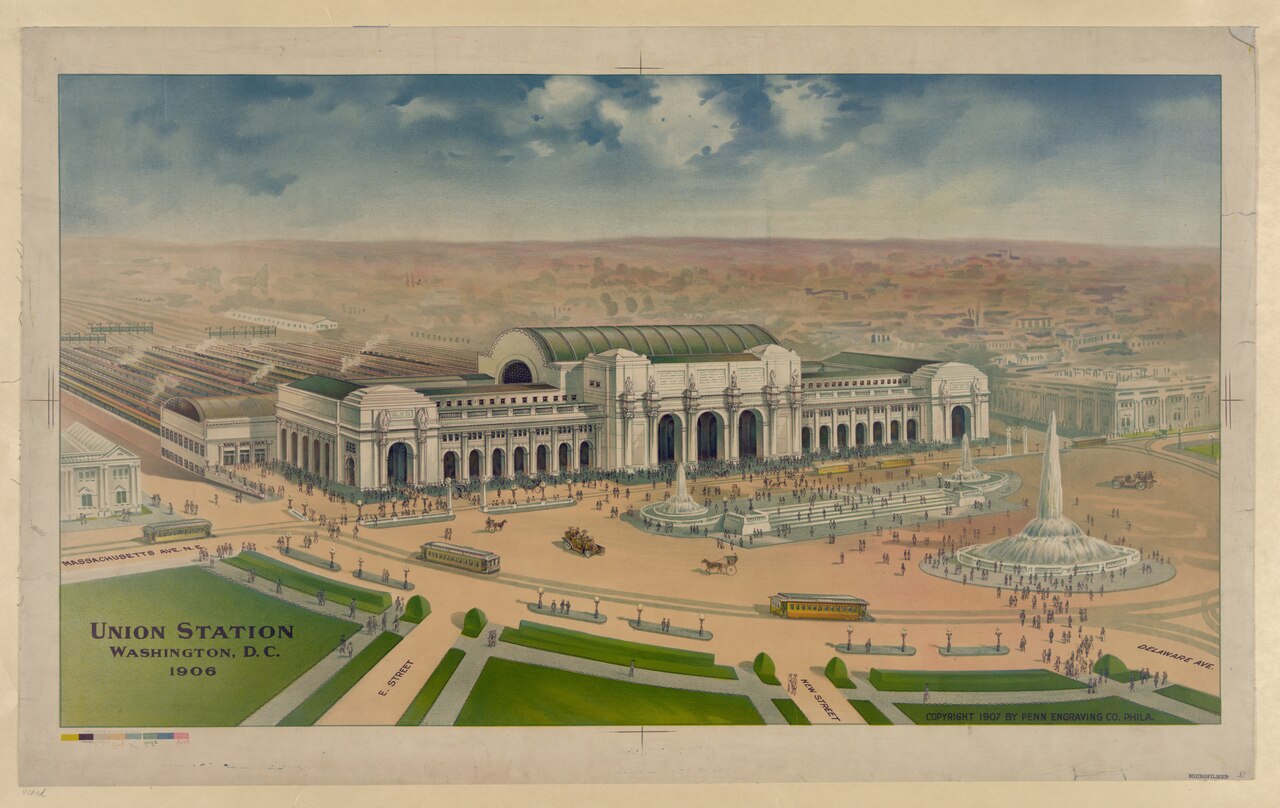
Defining characteristics
- Colossal classical entrances - triumphal arches and giant orders of columns
- Lavish glazed terracotta ornament on a commercial structural frame
- Beaux-Arts symmetry and axial planning at monumental civic scale
- Vast ceremonial interior spaces (waiting rooms, concourses)
- Sweeping historicist ornament applied to modern steel-frame buildings
Key figures
- Daniel Burnham (1846-1912) — Architect-planner whose firm developed the style for railroad commissions
Example works
- Union Station, Washington, D.C. — Daniel H. Burnham and Company (1907)
- Reliance Building — Burnham and Root (1895)
Sources
- Burnham Baroque - Wikipedia encyclopedia